
let the bridge burn
that feedback loop of bad media and the dead it leaves behind

A colleague recently said to me: “It just takes one stupid person...” What she meant was: it just takes one member of the public to call and complain, and you’re done for. — Xue’s Dancing with Disappointment1
Mr. Ng explained: [quote] “Itʼs a protest performance. I agree those men (who were arrested) were guilty of soliciting. But the press didnʼt have to print their names. And why were the men caned when they had already received a jail term?” [end quote] —The New Paper, January 3, 1994. Reported by Ng Li San
(i) “Sometimes silent protest is not enough”
I was only nine when the ban for performance art was passed. Well, performance art could still go on but without any funding support from the state and non-scripted performances which included forum theatre was not allowed. This ban lasted ten years and was lifted in 2004. Those who were actively practising during that period called in The Dark Age of Performance Art in Singapore. Brother Cane continued to be mentioned time and again, taking on a mythic form that cultivates a kind of potency that warns each generation in the repercussions of acting out of “ob markers” and getting caught while doing it.
By the time I was an art bb (sometime in 2008), I was caught in the floods of a dam that finally broke free. Like flowering trees after a drought. There always seemed to be some performance art thing, either at Substation or Your Mother Gallery or outside the chapel. Everything was independently organized and felt raw and unruly. These performances seem to be melding so many elements together; dance, poetry, sound, some other fourth or fifth thing and the word experimental was like the vibe of that era. It was a wild and wonderful time though I suspect somewhat a glimmer of what it might have been if that dreadful media coverage never went to print. I’ve always wondered if what I was witnessing was the compromise, how rich and vibrant it could have been if the ban did not happen.
Details of Brother Cane were always kinda blurry. Among my peers, we mentioned it in passing sometimes when sending something off to IMDA or participating in unlicensed performances as a reminder of sorts that things can go south. I truly felt that instinctual force to always hold back, playing with concealment and camouflage, was how regulation had affected my practice (but this is for another day and another post I guess). On writing this, I scoured the many fragments on Brother Cane, starting with Loo Zihan’s archiving and performance score and Lee Weng Choy’s Chronology of a controversy to kind of build a fuller picture of how these events unfolded.
SUNDAY 26 DECEMBER 1993 to SATURDAY 1 JANUARY 1994
The Artists’ General Assembly (AGA), a week-long arts festival, takes place at the 5th Passage Gallery in the Parkway Parade Shopping Centre. Organised by The Artists Village and 5th Passage Artists Ltd., the festival includes sculptural installations, live music, poetry readings, an international video festival, performance art and a forum on the state of alternative art.
Some of the events of the festival are covered by The New Paper (TNP). No other representatives of the media attend (as far as the organisers know). Also of note, just two days before the start of the festival, the Board of Film Censors ban three videos (out of the more than 100 in the video festival).
The Artists Village was founded in 1988 by Tang Da Wu and a group of young artists, and was originally based in a kampung studio space in Sembawang. The artists work in many mediums, including painting, sculpture, installation and performance art. In general, the works are experimental and avant garde. Some of the members (at the time of the AGA) were: Amanda Heng, Koh Nguang How, Zai Kuning, Lee Wen and Vincent Leow. 5th Passage Artists Ltd., founded in 1991, has managed the only artists collective gallery in the country. Run by Suzann Victor, Henry Tang, Susie Lingham and Iris Tan, the group has focussed on issues of gender and identity, and on the work of women artists. It has strongly supported alternative art and music as well as performance art.
A few things to note:
Vincent Leow’s performance of drinking his own urine during the same New Year’s Eve caused the same public outrage but without any repercussions from the state or council. I tried to find more information if this too was an act of protest but the strange media coverage only quoted him for wanting to find new ways to get the attention of the public.
Both Josef Ng’s and Shannon Tham’s performances were in protests of media coverages; for Ng it was how the 12 gay men who were found guilty of soliciting had their names exposed in the papers and for Tham it was the media’s coverage over sensationalizing the screening of a blank tape after it was censored by IMDA or according to another account on moshing at rock concerts. Tham had burnt The New Paper and then vomited on it as it burned. Ng laid out the article 12 Men nabbed in Anti-Gay Operation at Tanjong Rhu” from The Straits Times during his.
Josef Ng was 22 years old and Shannon Tham was 20 years old at the time.
Outcome (taken from Weng Choy’s Chronology of a controversy):
FRIDAY 21 and SATURDAY 22 JANUARY 1994
The Ministries of Home Affairs and of Information and the Arts issue jointly a statement making clear the Government’s disapproval of the two performance art pieces. The next day ST reports (22.1.94):
[The Government] is concerned that new art forms such as “performance art” and “forum theatre” which have no script and encourage spontaneous audience participation pose dangers to public order, security and decency, and much greater difficulty to the licensing authority.
“The performances may be exploited to agitate the audience on volatile social issues, or to propagate the beliefs and messages of deviant social or religious groups, or as a means of subversion,” the [Ministries’] statement said.
The following action will be taken:
Police will reject all future applications by the group 5th Passage for a public entertainment licence to stage any such performance without fixed scripts.
The two men involved in the acts will be barred from future public performances. The police will reject applications for public entertainment licences for any performance or exhibition by 5th Passage or any other group involving artist Josef Ng Sing Chor, 22, and art student Shannon Tham Kuok Leong, 20.
·The NAC will bar 5th Passage from getting any grant or assistance. It will also not support “performance art” or “forum theatre” staged by other groups, but their other projects will be considered.
Iris Tan Khee Wan, a founder-member of the group and organiser of the event held at Parkway Parade from Dec 31 to Jan 1, will be prosecuted for providing public entertainment without a licence, as the performances continued past the approved time.
Organisers of scriptless public performances will have to provide a synopsis when they apply to the Public Entertainment Licensing Unit for a licence. If approved , they will have to put down a security deposit.
Kai Lam: Yeah, okay. I was an art student in 1994. At that time I feel the energy was very good. It was quite an exciting time. I witnessed many individuals coming together to do performance art. And then the controversy happened and the Singapore government banned funding for all performance art until 2004. I called it The Dark Age of Performance Art in Singapore. Nobody knew what was really going on. Some people thought that performance art was banned, but in reality, it was really only funding that was banned.
Anyway, it threw the performance circle into a bit of confusion. Lee Wen was quite an important figure at that time because he continued to practice and promote performance art. It is through these kinds of small steps that government authorities notice that they cannot ignore this form of art for long.
The fact that NAC banned performance art and forum theater for so long makes me think it is not a neutral organization. It is discriminating against a certain form of art. As far as I know, the National Art Council or the government has never addressed or commented on the artists who are banned for life. Not to mention Josef Ng was only 21 years old, and was a student at the time. Now performance art is supported again, but they never re-addressed the issue regarding those two artists. I find it very problematic. Funding bodies should be more neutral. NAC is a statutory board under MICA (Ministry of Information, Communications, and the Arts); therefore they may be partial in their funding policies, because they would have to fall in line with the larger Singapore government agenda.2
5th Passage had all their licensing in place for the festival. However the timing went over the limit even though they had applied for it to go on until the early hours of 1st January. It was a lapse on IMDA’s end. Iris Tan who was the manager was charged for this lapse but then later it was amended to that of allowing a "vulgar act" to occur, in breach of the conditions of a public entertainment license. =_=
The infamous cover of Josef Ng’s butt cheeks and the title Pub(l)ic Protest, need I say more. I cannot access the digital version of the article but I am wondering if the focus was more on the nudity and actions rather than the message?
NAC’s taking care of their ass the following day with this statement is giving some kind of paternalistic vibes especially in the last paragraph.
TUESDAY 4 JANUARY 1994
The National Arts Council releases the following statement:
The National Arts Council (NAC) noted with consternation the report in The New Paper, Shin Min and Lianhe Wanbao yesterday (3.1.94) of two artists putting on so-called performance art: One snipped off his pubic hair while the other vomited, both publicly in protest against allegedly unfair reports by the press.
NAC finds the acts vulgar and completely distasteful, which deserve public condemnation. By no stretch of the imagination can such acts be construed and condoned as art. Such acts, in fact, debase art and lower the public’s esteem for art and artists in general.
If an artist has any grievances there are many other proper ways to give vent to their feelings. Artists with talent do not have to resort to antics in order to draw attention to themselves or to communicate their feelings or ideas. By staging such tasteless performances, 5th Passage or any other arts organisation for that matter cannot expect any form of support or assistance from NAC.
The public in 1994 did not experience Brother Cane. Instead they encounter it through that newspaper article and the way it was framed If that is how one artwork could be transformed and re-presented to the public, then it is worth asking how many other performances, and how many other forms of art that the public have only ever encountered through the media and how much of these encounters are true to the performances’ intentions?
The Straits Times, February 8, 1994
Commentary by T. Sasitharan
Art is born of inspiration, not prescription. So each time the parameters of the permissible are re-drawn to diminish artistic space, more artists – often the more committed and imaginative ones – will be forced either to give up entirely or turn their sights on safe but dead and fossilized forms imported enbloc from elsewhere or the past.
If this goes on long enough, all that will come out of the multi-million-dollar ovens of the Singapore Arts Centre will be a flat, distasteful cultural cake, condemned to stand forever on the shelves of the international marketplace of the arts.
Sure, you will always have your Cats and your Les Mizs and your Chorus Line and your Tresors. But you will have nothing of the soul of Singapore and nothing of ourselves holding it all up.
What the likes of Ng and Tham do now may be nothing more than a minor footnote in the history of Singapore art when it is finally written. But if artists here lose the verve, conviction and imagination to go on doing honest and uncompromising work, that history may not be worth writing at all.
I am not sure if all that regulating actually enlivened the performance art scene in the following years but I remember experiencing so much of it that I became its progeny. When the body protests, the body performs. When the body performs, the body protests. These performances were affirming especially since performance art was considered to be the black sheep somewhat; badly compensated, highly tokenistic, almost always a spectacle for an opening or closing of an exhibition of the rEaL art itself. Yet somehow those in the scene (or adjacent to it) persevered and continued to do what they were moved to do no matter the conditions and regulations.
A big part of me still believe that the whole Josef Ng debacle could have been avoided, its repercussions still very much felt today. I felt it took away criticality as well in the midst of flattening everything and making it safe. By the time I got into performance art, there was some kind of homogeneous elements that I was compelled to abide to; colors were always red, white or black, there’s some kind of burning, ashes and candles, some ritual, some crying and screaming, there was gesticulation and mastication of things like sand or fruit or flower, some test of endurance for the body. The messages within these performances however were kinda unclear, at least to me. If this was a protest, it was only allowed to exist in a whisper.
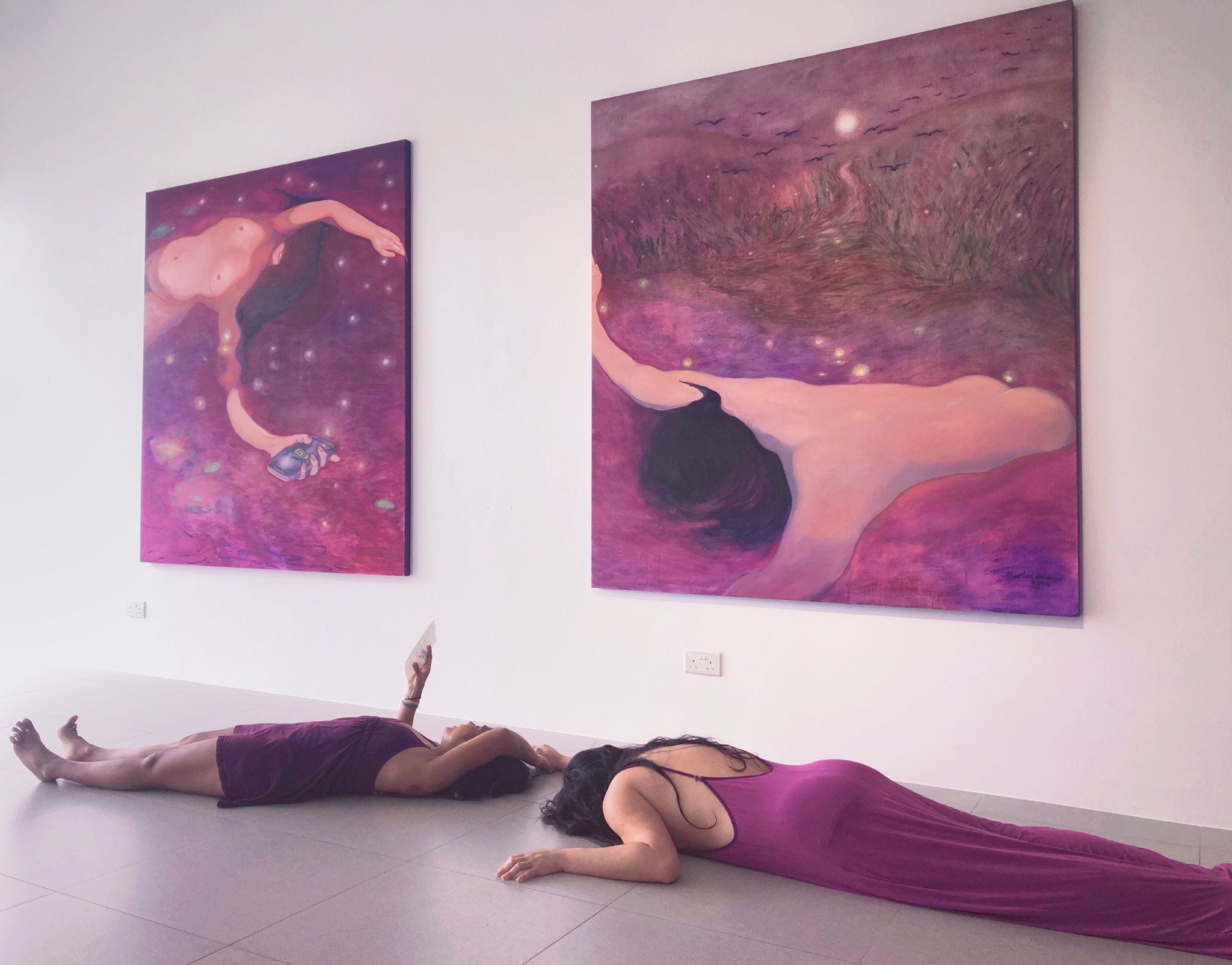
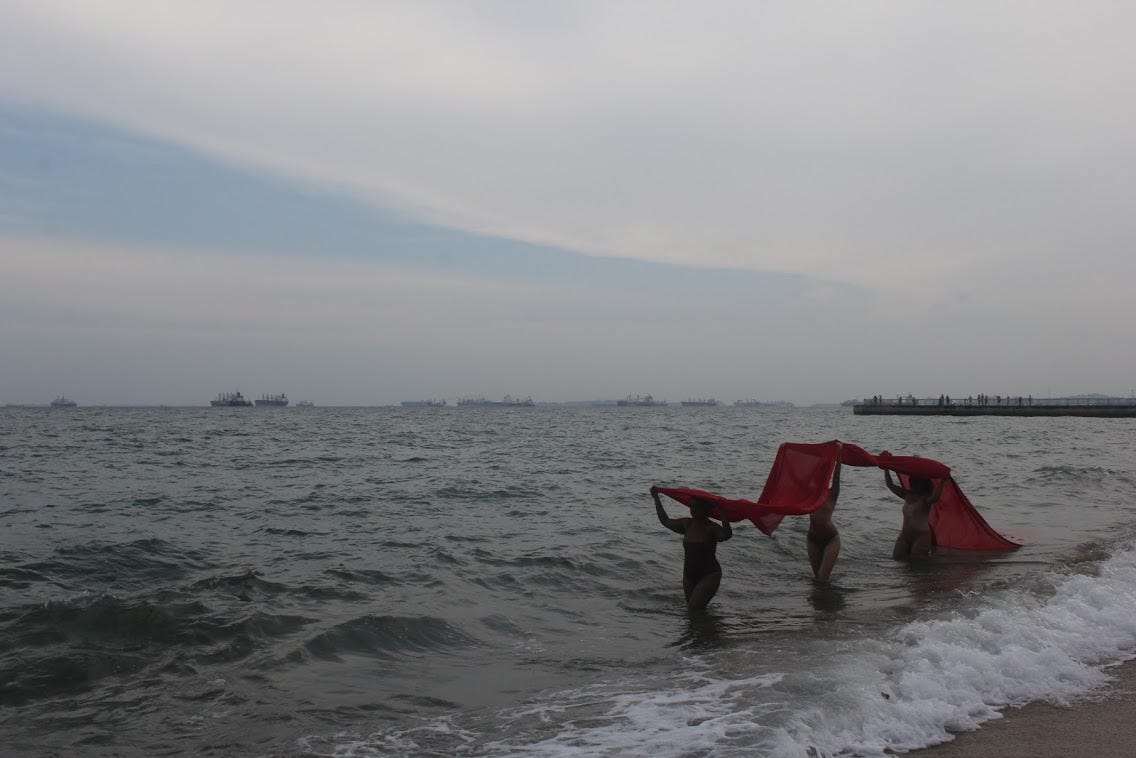
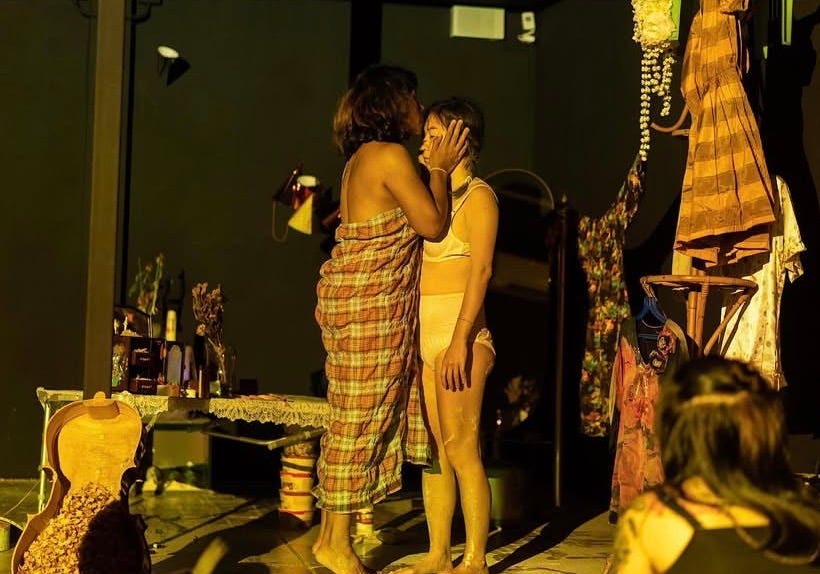
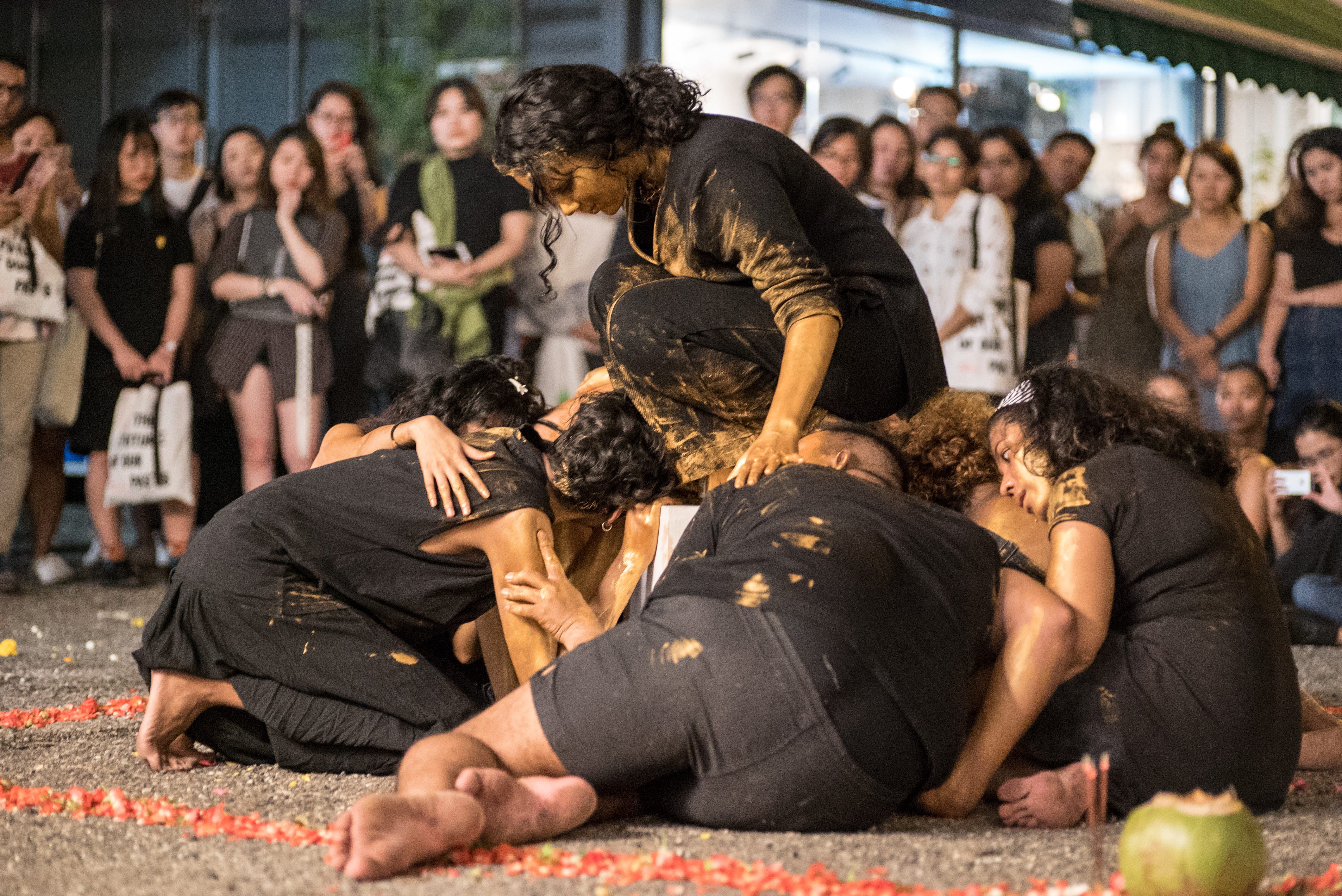
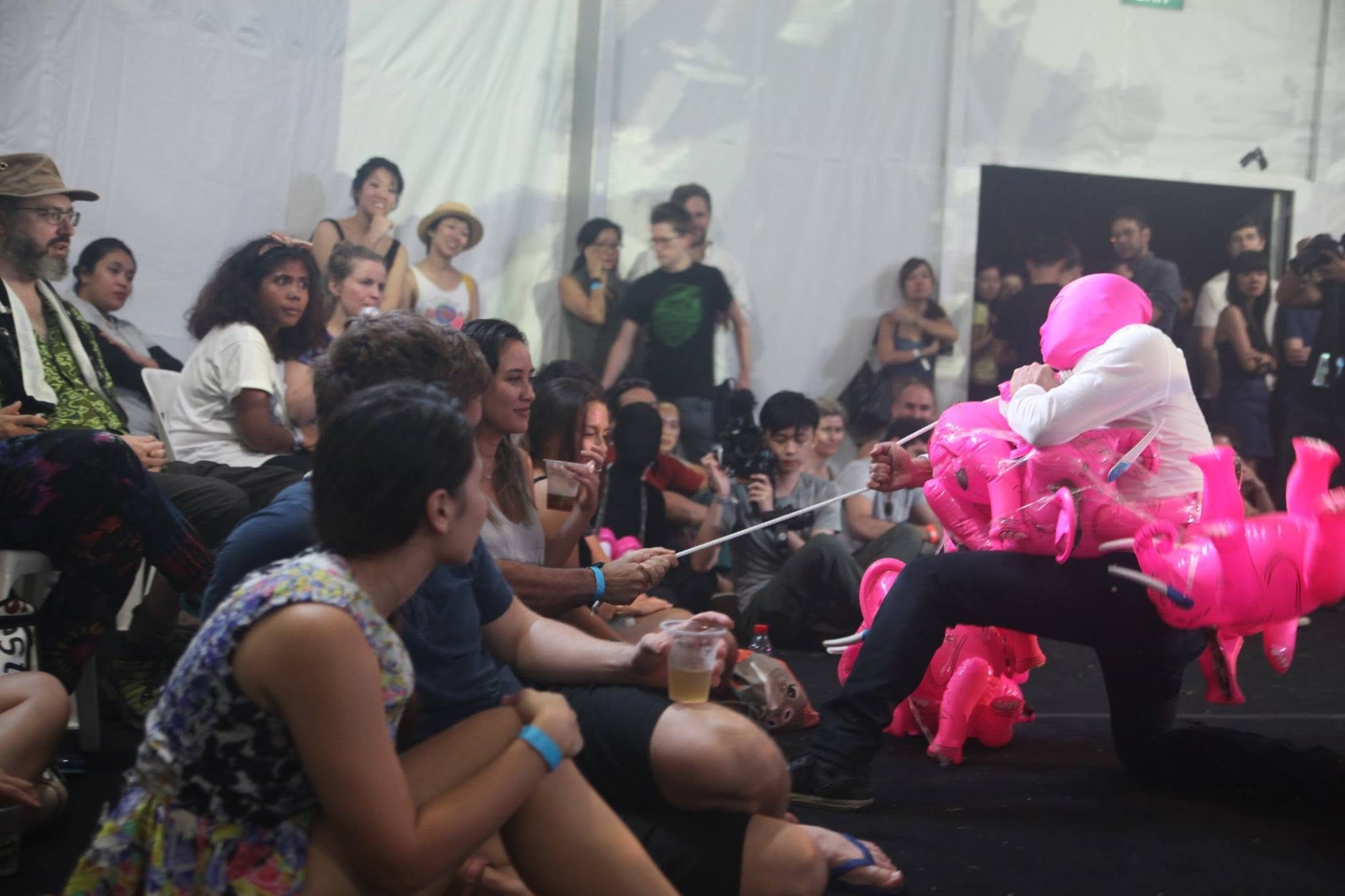
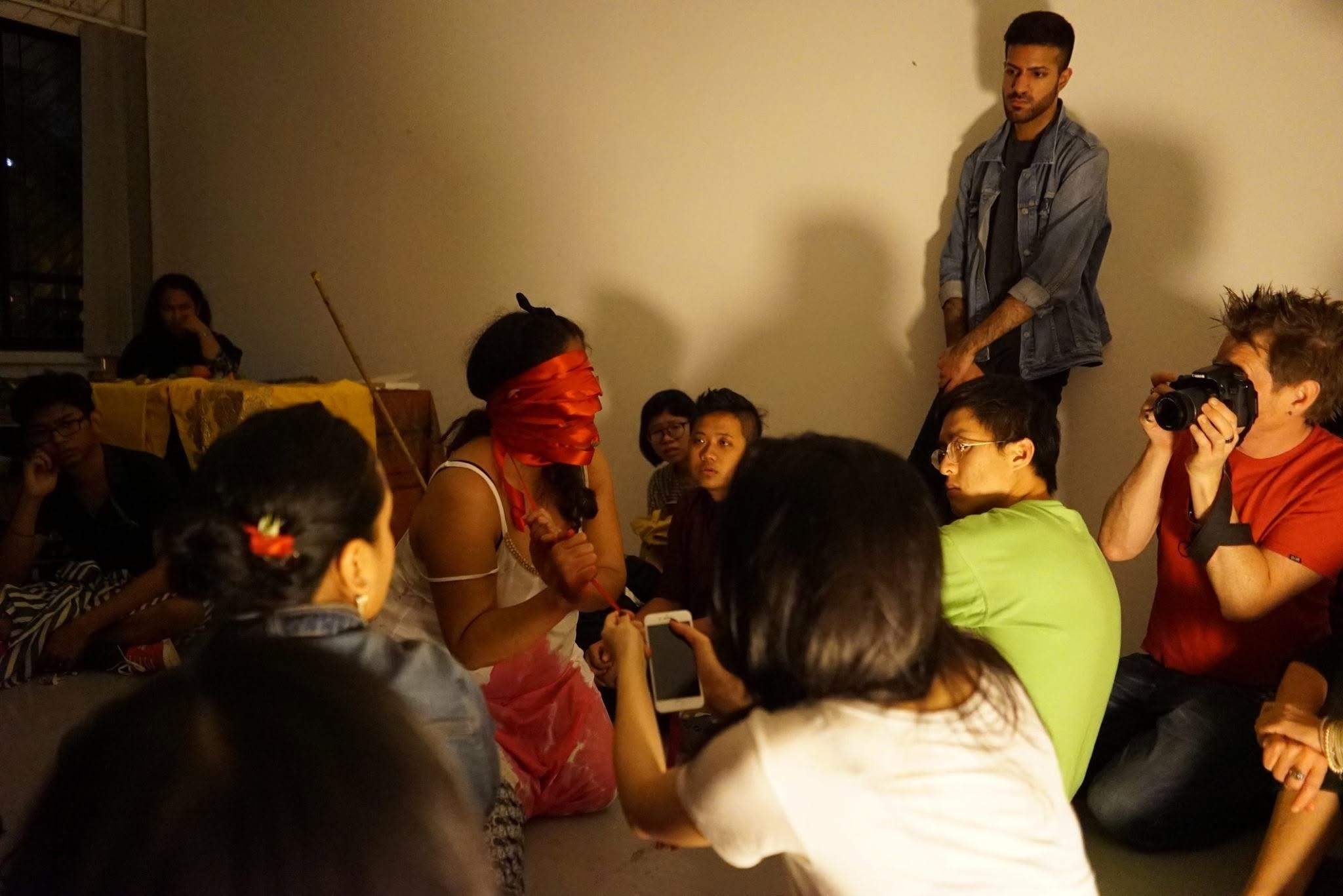
But what remained is that undeniable immediacy between the public and performer and their proximities, the vulnerable and intimate space between us, that strange feedback. This drew me in and witnessing those whom, not surprisingly, came from the era of 1994; always made me feel some sort of way in my core being. They were doing their own thing in their performance practices. And then there were my peers whom I’ve looked up to and for a period I thoroughly enjoyed and felt transformed by our performances together. All of this made me feel like it was always ok to push just a little bit more and join the many hands rocking the boat.
Performing Protest in Singapore: Performance Tactics in Brother Cane and Don’t Give Money to the Arts - Wei Hao Goh
Considering the public profile and physical locations of the performances, it would seem more fitting if Don’t Give Money to the Arts received the backlash instead. However, what is more important than the physical site of the performance is for artists practicing in Singapore to learn to navigate the “out-of-bounds markers.” “OB markers”, as it is more commonly known, is a colloquial term used in Singapore to mean the boundaries that define what is considered acceptable political discourse and expressions by the government. Transgressors face indeterminate penalties ranging from public rebukes to criminal charges. But these markers are often ill-defined and constantly mutating; the only way to know where these boundaries lie is to cross them and risk being penalised.
And yet always, I find myself holding myself back even if my entire brazen body was ready to set things on fire. For we are always reminded of the consequences if we go out of line (or if we get caught doing it). Examples 1 2 3 43
Perhaps that is Brother Cane's longest afterlife. Not the funding ban, nor the decades of debate, but the way a media coverage became more enduring than the performance itself. For many of us who came later, we inherited not the work but its mediation. The way that insidious fear manifests in its sly ways, its tentacular grip rips the unruly at the bud. We continue to live the consequences in our bodies, which nullified the true meaning of Brother Cane from our consciousness, that we must fight an injustice when we see it happening, amplify ourselves doing so, believe in what we do so that others will believe it too because sometimes silent protest is not enough.
(ii) there can be no touching here
As the internet shifted into Web 2.0, there was a proliferation in what constituted as media. Our ability to comment, like, respond and share at an accelerated rate changed the shape of media itself and ways in which it echoes, influences and shape public opinion. A groundswell that is slow and undulating [created by a distance storm over long periods] in which public opinion may shift is replaced by virality, much like a virus, spikes suddenly, infects in large numbers and disappears just as quickly to another thing.
Between 2018 to 2020, which I believed was my strange awakening to the injustices around me especially as I was learning how to parent my child who is born with multiple disabilities. It was also during this period that I was spending a lot of time with peers who were much younger, who were unapologetic in their ways and taught me a lot about politics of race, and queerness, and gender; things I already knew and lived through but never had the words for. Everyone had strong opinions, always carving out think pieces shared over long instagram posts, drenched in therapy speak and throwing words like gaslighting and accountability around. We were all woke for something we believed in.
Somehow, somewhere a bunch of us younger artists got involved in a show where a known sexual predator (who served time for his crime) was included but under a different name and we were scheduled to perform and did an activation where were confronting the organizers, (actually it was just one senior artist who was an important figure in performance art) and it got rather ugly really fast and all this may require another post in itself at a later time because I haven’t really processed it all even though many years have passed.
Somehow on a larger scale, I began noticing a pattern. Public attention seemed to settle, almost instinctively, on the victim-survivor rather than the perpetrator, who was so often shielded by authority, reputation or power, weakened by doubt placed against accusations . Every new case unfolded in familiar ways. People scrutinized timelines and motives, searching for inconsistencies that might make the discomfort disappear. It became less about understanding harm and moving through it generatively and instead more on trying to put it all away.
But that when the seed, the rage with no place to go, had to be quelled by softness. So I kept reading. I attended AWARE’s first responder training, spoke to counsellors, facilitators and survivors, and spent my residency at The Substation conducting workshops around consent, care and collective responsibility. Sexual assault cases kept recurring (there were three in the arts at that time and one involved discussion with an art institution about whether a perpetrator was to be included in the biennale) and almost aways there was error in our responses or efforts for restoration goes cold. The trajectory was of course inspired by Monica Baey’s bravery into coming out and calling out the lack of support from institutional bodies.
I thought I was researching sexual violence, but somewhere along the way I realised I had become interested in something adjacent to it.
It was the accelerated rate in which media spreads the way there are being shared, leaving no space for compassion. Compassion and empathy require time. It asks us to sit with contradictions, to acknowledge that harm can be devastating without immediately collapsing these injustices into content. But virality is a sickness that rewards the reckless spread and its immediacy in responses. The decentralizing of media bodies into podcast bro culture and problematic news outlet disguised as aLtErNatiVe rely solely on engagement to sustain and profit and it encourages and rewards the hyperbolic, decontextualized and overdrawn responses from the public.
The damage is manifold and uncontrolled. It spills and spreads and stains everything in its wake and then it moves on to the next thing. Misinformation is rampant and people rely on the framing of things rather than thinking for themselves. In 2020, I created There Can be No Touching Here, a collaborative effort with Izyanti, to shed some light on the audacity and absurdity in which an account on a sexual assault case can grow tumorous and monstrous on social media.
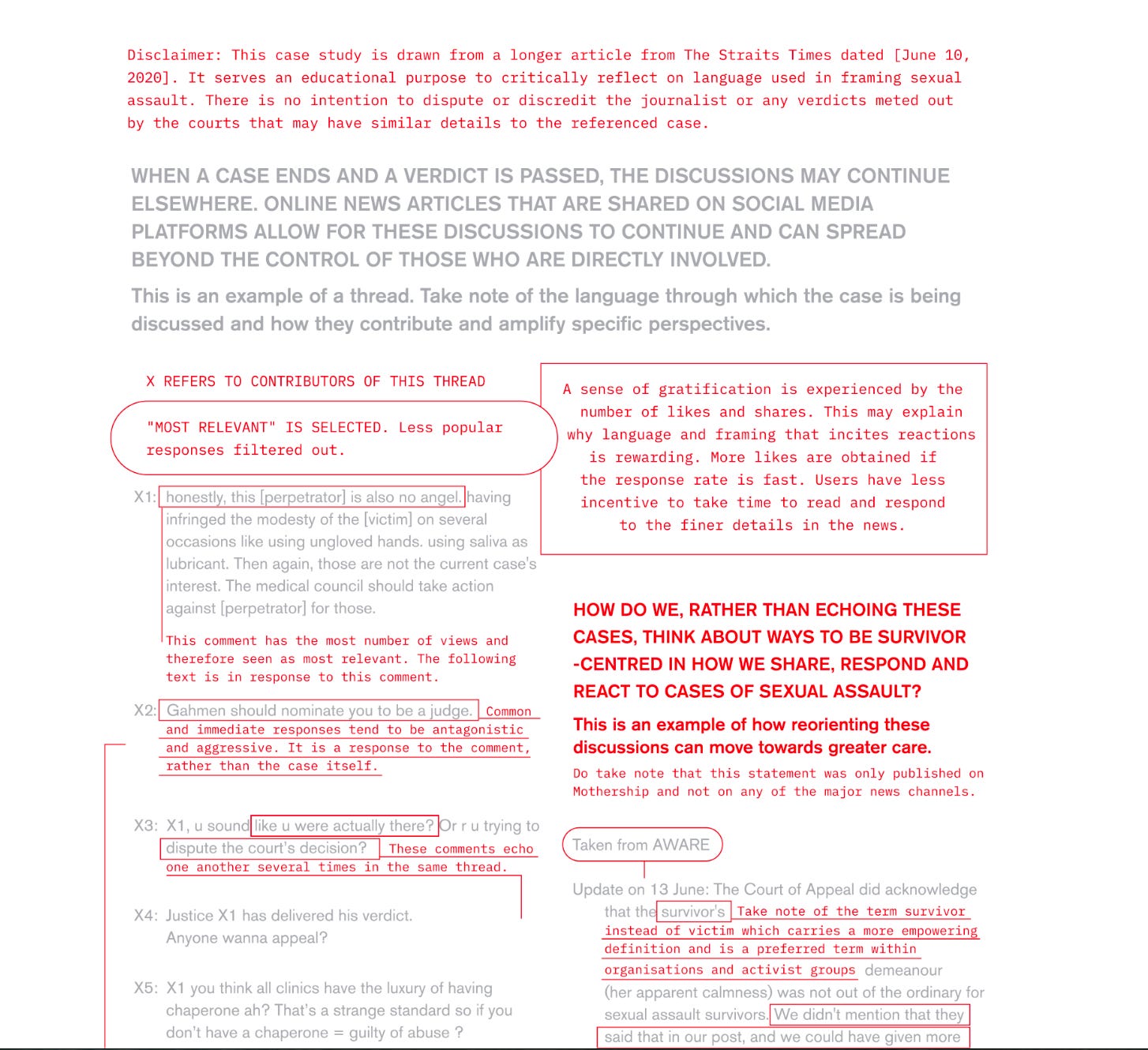
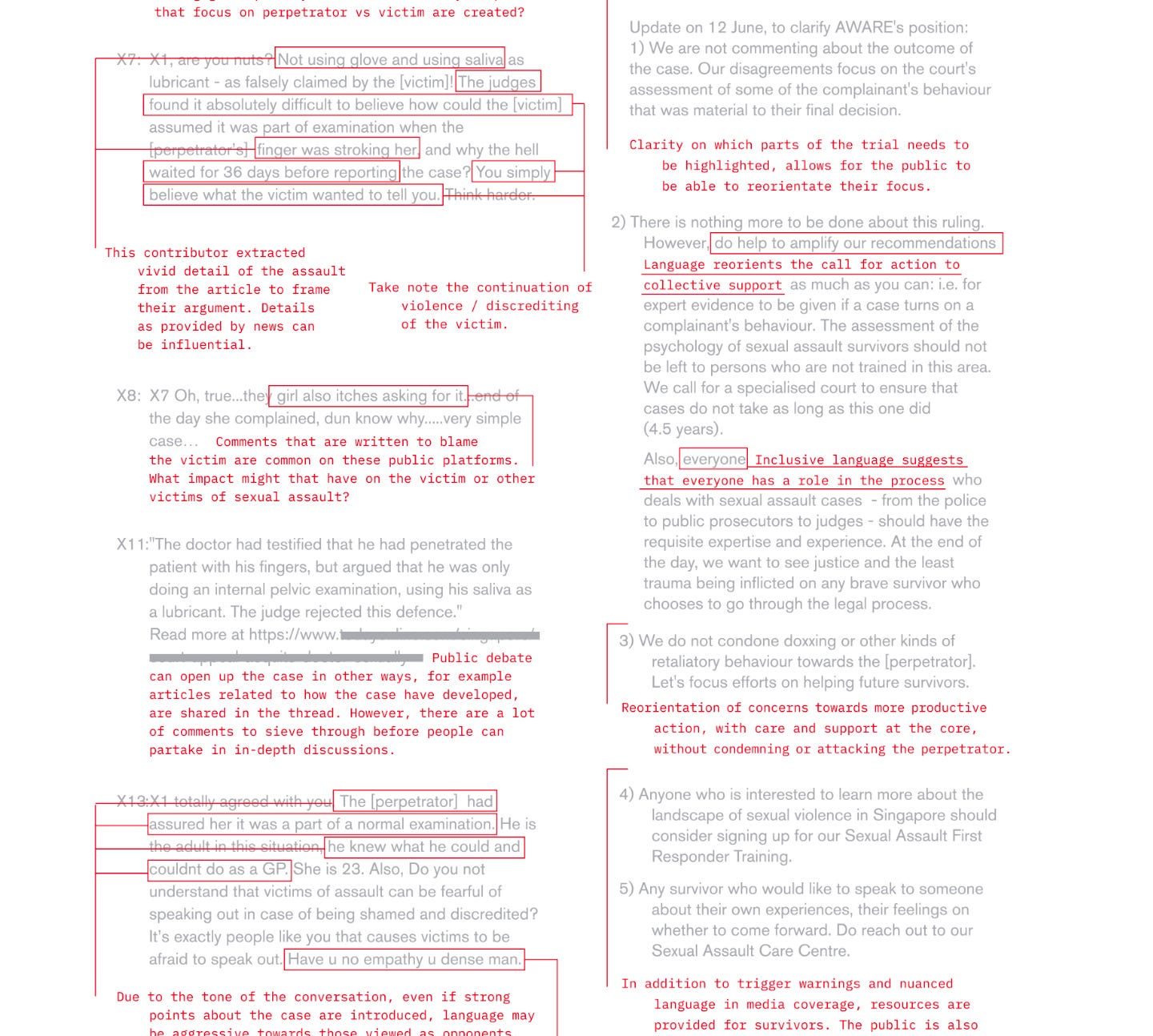
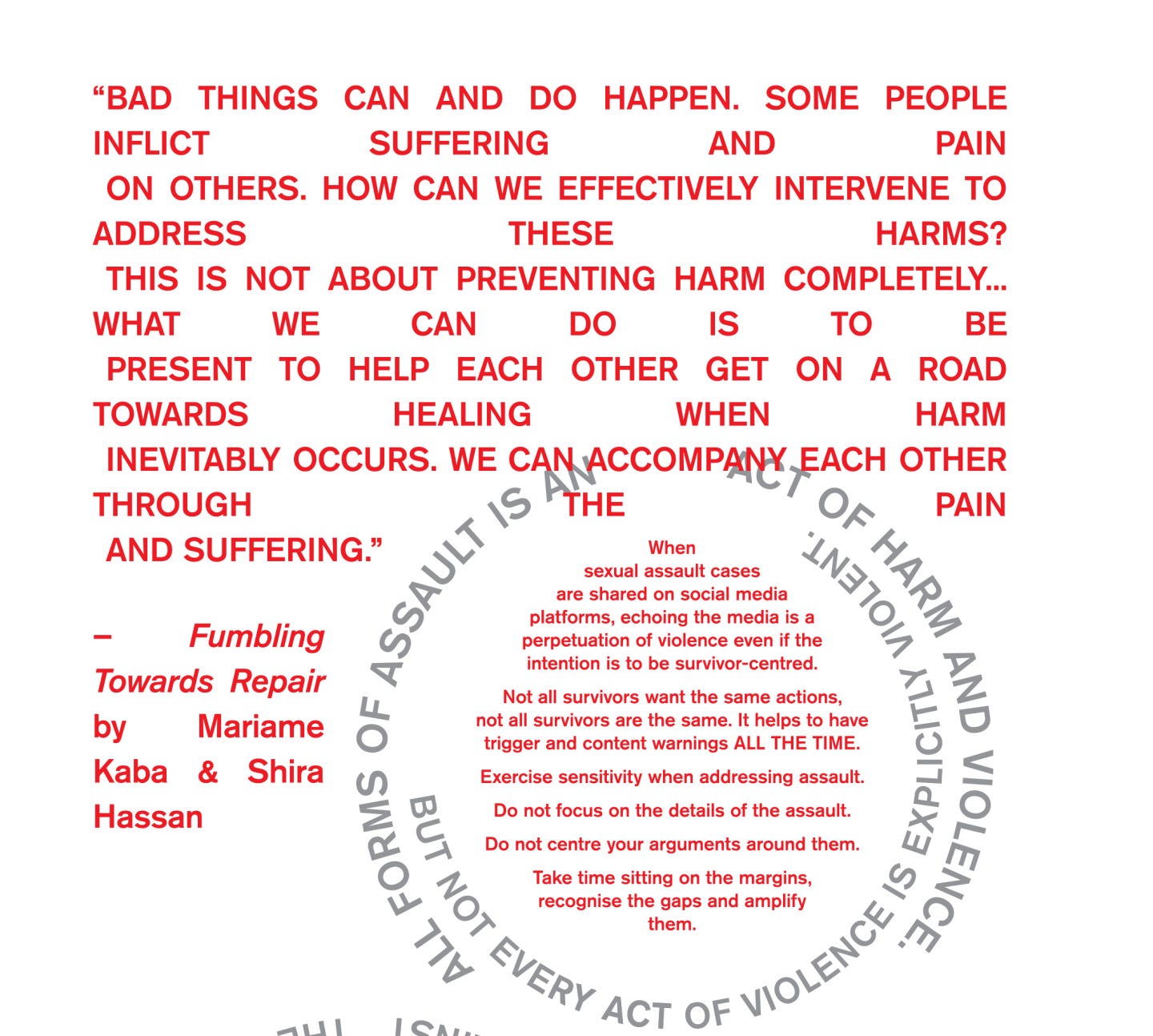
The work is made up of three banners. The first reproduces a news report of a sexual assault case. The second places a social media post about the same case alongside a trauma-informed response by AWARE, exposing the stark distance between reaction and care. The last banner is a kind activation in which I frame and invite a kind of reorientation in the ways we can rethink presence, proximity and encounter. How can we, as Mariame Kaba and Shira Hassan wrote in Fumbling Towards Repair, “accompany each other through the pain and suffering?”
Has things changed since then? Not really tbh but I have not stopped trying to challenge bad media representations and their repercussions, no matter how small my efforts are. I see others doing it too [1, 2, 3]4 and I am heartened by these efforts. And though we may be so far away from an overhaul, it does not mean we ever stop trying. Maybe it’s time to burn the bridge completely and all its rotting terrain and let something else grow in its place; a slower, loving thing that holds us through our joys and pain.
(iii) a loving thing, our holy union
I heard about Berahi: Holy Unions, a work by choreographer Norhaizad Adam which is performed together with his life partner Hasyimah Harith, in the early days of its conception. My partner was approached to create the sound design and music for the performance and had come home excitedly one night telling me about their upcoming work. He had mentioned that it would include Khatijah Terung’s texts taken from her 1911’s manuscript Perhimpunan Gunawan bagi Laki-Laki dan Perempuan (A Compendium of Charms for Men and Women) which contained a list of charms and spells that would heighten sexual pleasure and ensure marital fidelity. (I never knew this text even existed and was completely blown away by the fact that they were bringing it to the stage).
Syimah and Haizad have been putting exciting and playful works out since I’ve been following their work from their collective P7:1SMA since the early days of Belon in 2016. I have also been working closely with Syimah since 2023 in our collective (with three other brilliant 30-somethings) exploring ways to activate and encounter eroticism in our practices and with one another. As their work begin to take shape, I grew even more excited seeing the promotional marketing being shared online.
Another brilliant artist I admire, Khairullah Rahim, known for his queer, camp and bedazzling creations, created the costumes. Diamond-studded BDSM face mask veiled beneath a lacy selendang held by a sanggul crown and a whip made of jasmine-chain hangs loosely at the front of the songkok. n the short clips on Instagram, Haizad and Syimah move in these creations, in their luminous jade green baju catching the light with each rhythmic turn of the body. Such potency I can almost taste the heat of the erotic through the screen.
A week after their residency in Hong Kong in which they performed the work and a week before their show’s premiere here under Dance Nucleus Latitudes [Part 1], a toxic hyperbro podcast channel Planb with a large demographic of Malay-Muslim followers released a ragebait post about their performance with the title Topless Dancers and BDSM elements feature in Malay dance performance.The videos from the post which consisted of bits taken from the performance in Hong Kong without asking either accounts to give more context to the work. They also incorrectly state that the work was choreographed by Haizad and Sarah Aiken who was another dancer-choreographer that was part of the double bill.
The final straw was the misleading statements on how the performance in Hong Kong caused “heads to turn” (not attributed anywhere) which depart from traditional norms which some viewed as being oversexualised. Not mentioned who these “some” are either. There is a falseness of plurality in the reactions because firstly the work has not been performed in Singapore so these comments were not based on the work itself and I correct myself when I say these comments because they screenshot one lousy comment by one single user. Merepek sak. I mean guys if you need content, just stick to your misogynistic, xenophobic, sexist fodder and leave good art alone.
This obviously caused a fucking uproar with the Malay Muslim public being up in arms about the performance. Which is understandable BUT one cannot help but wonder if the framing had been a little more TRUTHFUL and a little less sensationalized, would it generate such levels of engagement in the first place. Aside from this unnecessary backlash, I knew firsthand that there were already some challenges in acquiring a license on IMDA’s end for the religious connotations that was written in the manuscript. So I could only imagine what both of them may be going through with fires from all around to be put out one week shy of their premiere. It felt like Brother Cane all over again when something has been decontextualized and faces a risk of being shut down.
A couple sit side by side, bertandang di pelamin, of a holy matrimonial celebration. The man wears a songkok, his face covered with chains of jasmine flowers. The woman face is covered too in a lacy selendang and sanggul. They are in matching sheer jade green baju. The music comes in and they dance the joget serampang 12, made up of 12 steps in a courtship of a young man and woman.
As the dance ended, Haizad picked up the microphone at the centre of stage hidden amidst stalks of fresh flowers and introduced himself. “My name is Haizad. I am a traditional Malay dancer, a contemporary artist, a son, a father and a husband”. He gestured towards Syimah and says, “And that is my wife”. Passing the microphone to Syimah, she does the same and introduces herself. They then shared with the audience the meaning behind the joget serampang 12, as people from the Nusantara before stating that they have been married for 10 years and are finding their spark again. Here they share a little bit about Khatijah Terung’s charms as a way to relight their marriage.
This introduction not only broke the fourth wall between audience and performers but carved out a tender and intimate space. It was honest and genuine and set the mood for the entire performance. That we are here to glimpse into their process of finding one another again, the charms a conduit for something deeper and more complex. Throughout the performance you catch little gestures hidden in the choreography, the way Syimah hits Haizad and nudges him playfully, how he wipes a spit of betelnut leaf from her cheek, the way they look at each other and how they hold their gaze that only a couple that have been together know of and we became witnesses to their shared language of intimacy.
I love the many scenes, Syimah and Haizad lowering themselves down while slowly chewing betel nut leaves and moving closer almost in a kiss, Syimah rubbing lime on the sole of her foot which appears raised to Haizad’s cheek moments later, the gaze held in the mirror, the flipping of the jasmine whip as the petals come apart, the choke of the neck reciprocated and never once did the bodies touch, always at a close distance which made it all the more erotic.
In the middle of the performance, Haizad and Syimah broke the fourth wall again. While arranging stalks of fresh flowers, they shared that in Khatijah Terung’s charm, the jasmine flower spirit can be conjured to make their deepest desires come true. They shared their own desires before asking the audience for ours. A shy voice hesitated and replied “I want the beginner level kind”. The room bursts in laughter, the atmosphere feels easy and relaxed. Haizad picks up a lily and tells us that they have a daughter whose name is Lily and shares the names of their three children and their ages, before pausing at Lily and sharing that she’d be four and that she has passed. “It’s ok we will meet her again one day”. “For Lily,” said Haizad as they picked up the jasmine petals and threw it in the air.Their grief was palpable and for a moment my heart clenched at the thought of losing my child.
Khatijah Terong’s charm comes in a snap of a whip: Charm 41 & 42 — Broken grows back, lost, comes back…
The atmosphere transforms into a heady sequence involving the BDSM elements. A vibrator is switched on and moves on a carpet, Haizad undresses revealing a bondage harness and is holding a flogger. The couple are at a distance from each other. Haizad flogs himself and Syimah sits on a chair facing the mirror, turning her body slowly and carefully. Haizad puts on a bondage hood over Syimah and adjusts her head and hair. The BDSM elements are there but used heteronormatively which is again, feels honest and genuine. Here we have a couple experimenting with one another and trying to figure things out.
In the epilogue they danced with to the reversed melody of the Serampang 12 dance. They seem to be in sync, smiling and looking at each other with a slow burn kinda passion. We all clapped in triumph for this brave couple who pulled through despite the backlash and gave us this wonderful and honest work, and all the feelings that it brings. There was nothing obscene and salacious about it and I hated that most of the normie Malay community did not give it a chance it deserves.
During the QnA session, Syimah mentioned something that resonated with me and might stay in my body forever. She confessed that it became hard for her to move after all the resistance they faced towards the work and she was questioning everything. “How can something created from love, bring so much pain?” </3
I haven’t stopped thinking about that question. And I feel it in my bones.
Perhaps that is the real violence of bad media. It is not simply that it misrepresented a beautiful work. It makes artists doubt the very impulse that brought the work into being. It turns generosity into something that must constantly be defended. Are love, tenderness and vulnerability dangerous things to lean into and learn from?
And yet, despite everything, Berahi: Holy Unions insists on love. Not as optimism, but as practice. As labour. As something two people choose, over and over again, in front of strangers. To make such a work today feels almost radical.
And we are damn lucky to witness this loving thing, our holy union.
Thanks for reading to the end my loves. Hydrate, ressociate and always stand up for one another. Till next time <3
Go read this if you haven’t already. tysm xx
Really good interview: https://magazine.art21.org/2011/09/09/talking-to-kai-lam-about-performance-art-invisibility-and-art-laws-in-singapore/
Not a comprehensive list and includes other forms of art. Let me know who/what I missed out on and I will add it in. But in other words, most of the time we never really know what can riled up the public, or influence the tone of the media coverage or be in trouble with the law. It is really the luck of the draw.
Again not a comprehensive list. This is what I’ve come across and I’m sure there is many many more of such initiatives.
one of your best yet ❤️